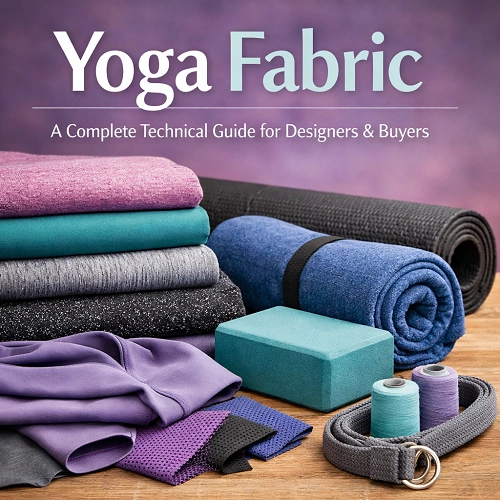
Yoga fabric sits at the intersection of textile science and athletic performance. Understanding its construction, fibre composition, and finishing technologies is essential for anyone sourcing activewear materials. This guide walks through every technical layer — from raw fibre to finished roll — with a focus on innovations pioneered by Zhejiang Wanjie Textile New Material Co., Ltd.
Yoga fabric is a category of high-performance stretch textile engineered specifically for low-impact to moderate-impact movement. Unlike standard apparel fabrics, it must simultaneously deliver four-way stretch, shape retention, breathability, and skin-comfort — often within a single-layer construction weighing as little as 150–220 GSM.
Modern yoga fabrics belong to the broader sportswear fabric series, sharing core technologies with running tights, dance wear, and athleisure. What separates yoga-specific constructions is the priority placed on flatlock-seam compatibility, opacity under stretch, and a smooth, non-abrasive hand-feel.
The performance profile of any yoga fabric is largely determined at the fibre-blend stage. Three base systems dominate commercial production:
| Fibre System | Typical Blend | Key Advantage | Limitation |
| Polyester / Spandex | 80 % PES · 20 % EA | Excellent moisture-wicking; colour-fast | Lower breathability vs natural fibres |
| Nylon / Spandex | 75 % PA · 25 % EA | Superior abrasion resistance; soft hand | Higher cost; slower dry time |
| 100 % Polyester (textured) | 100 % PES | Cost-efficient; printable surface | No inherent stretch without texturising |
| Recycled PES / Spandex | 78 % rPES · 22 % EA | Reduced carbon footprint; GRS certifiable | Slight variation in consistency |
Wanjie Textile's Burnout 16 Wales 3D (ref. B-3D0016) is constructed from 100 % polyester at 180 GSM and 150 cm width — a specification chosen to balance structural integrity with the burnout chemical process that creates its signature three-dimensional wales surface.
Stretch performance is quantified in two axes: weft stretch (across the fabric width) and warp stretch (along the length). Four-way stretch — the standard expectation for yoga wear — requires elastane content in both the knit loop and the inlay yarn, or a sufficiently tight circular-knit structure to allow multi-directional recovery.
Recovery rate (how quickly a fabric returns to its original dimensions after deformation) is equally important. A low recovery rate leads to "bagging" at the knees and seat after a single session. Premium spandex series constructions from Wanjie achieve ≥95 % recovery after 50 wash cycles.
Technical note: Four-way stretch is achieved through circular or warp-knit construction with a minimum elastane content of 15–20 %. Below 12 %, the fabric may test as "two-way stretch only," which limits garment pattern efficiency for yoga applications.
Effective moisture transport in yoga fabric works through a wicking gradient — the inner face of the fabric must have a lower surface energy than the outer face, drawing perspiration outward by capillary action. This is achieved through:
Cross-sectional fibre geometry — tri-lobal or grooved polyester filaments increase surface area and wicking channel count.
Hydrophilic finishing — a durable finish applied in the dyeing process increases the fabric's affinity for water on the outer surface.
Open-knit structures — mesh panels or drop-stitch zones, as featured in Wanjie's mesh series, improve air permeability without sacrificing opacity.
The burnout (or devoré) process selectively dissolves one fibre type in a blended or pile fabric using a chemical agent — typically sodium bisulphate for cellulosic components or a modified acid for specific synthetic blends. The result is a patterned semi-transparent surface that retains structural integrity while reducing weight in treated areas.
For yoga and athleisure applications, burnout technology offers designers a way to introduce visual texture and ventilation simultaneously. Wanjie Textile's Burnout Series extends this concept with 3D surface engineering — creating raised wales, twills, and grid patterns that generate tactile depth without additional lamination.
| Product | Reference | Surface Pattern | Application |
| Burnout 16 Wales 3D | B-3D0016 | 16-wale raised rib | Yoga pants, leggings |
| Burnout 3D Twill | B-3D0002 | Diagonal 3D twill | Active tops, shorts |
| 3D Wales | B-3D0001 | Open wales, varied pitch | Studio wear, dance |
| Burnout 21 Wale | B-1905 | Fine 21-wale cord | Athleisure bottoms |
| Burnout 21 Twill | B-2248 | 21-wale twill surface | Yoga jackets, wraps |
| Burnout Grid Plus | B-2220 | Geometric grid relief | Performance tops |
The Burnout 16 Wales 3D is one of the most requested constructions in Wanjie Textile's active portfolio. Its 16-wale rib structure creates a directional surface relief that enhances tactile comfort against the skin while providing a premium aesthetic finish suitable for retail-facing yoga and pilates garments.
The 180 GSM weight strikes an important balance: heavy enough to maintain opacity under full-body stretch (a critical requirement for yoga pants), yet light enough to avoid heat retention during active use. At 150 cm roll width, pattern efficiency is maximised for both women's and men's cut-and-sew operations.
Choosing the correct GSM and roll width is one of the most consequential decisions a product developer makes. The table below maps garment applications to recommended weight ranges from Wanjie's portfolio:
| Garment Type | Recommended GSM | Width Preference | Key Performance Need |
| Yoga leggings / pants | 170 – 200 GSM | 150 cm | Opacity + 4-way stretch |
| Yoga bra / crop top | 140 – 180 GSM | 150 cm | Support + breathability |
| Athleisure outer layer | 200 – 250 GSM | 150 – 160 cm | Structure + drape |
| Studio shorts | 150 – 175 GSM | 150 cm | Lightweight + moisture-wick |
| Dance / performance wear | 130 – 160 GSM | 150 cm | Ultra-stretch + visual texture |
Post-production finishing significantly alters how a yoga fabric performs and feels. Common finishing treatments applied at Wanjie include anti-pilling treatment, antimicrobial finishing (for odour control), and optical brightening. Burnout fabrics receive additional heat-setting steps to lock in the 3D relief pattern before rolling.
For end-users and garment manufacturers, care labelling should recommend:
Machine wash cold (30 °C max) to preserve elastane recovery.
No tumble drying — heat degrades spandex at temperatures above 60 °C.
No fabric softener — softeners coat filaments and reduce moisture-wicking performance.
Wash inside-out to protect any burnout surface relief from friction damage.
Zhejiang Wanjie Textile New Material Co., Ltd. has been redefining fabric innovation since 2007. Headquartered in Zhejiang, China — the heart of China's textile manufacturing belt — the company supplies wholesale yoga fabric, corduroy, velvet, burnout, spandex, and mesh textiles to brands and garment manufacturers worldwide.
Wanjie's product range spans six core series: the Sportswear Series, Corduroy Series, Velvet Series, Burnout Series, Spandex Series, and Mesh Series. All specifications — colour, weight, width — are customisable on request, and the company holds a portfolio of patents and industry certifications that reflect its R&D commitment.
Request samples, custom specifications, or wholesale pricing directly from Wanjie Textile's team.
Contact Wanjie Textile →